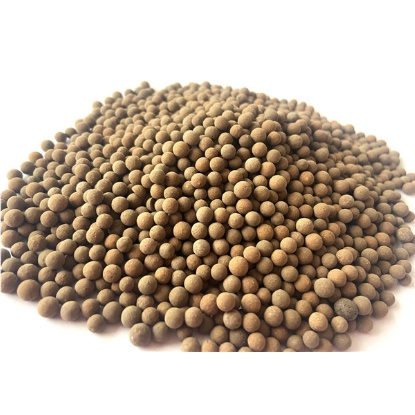
A near-spherical inorganic granular medium made from clay, shale and pottery clay with added pore-forming and binding agents, sintered at 1,100-1,300 °C and screened. It is usually reddish-brown or greyish-brown, with a rough surface and a well-developed honeycomb micro-pore structure inside.
Core role: a carrier for microbial biofilm attachment, used mainly in biological filters.
2. Operating Principle
Dual action:
Biological degradation (the primary function): the rough micro-pores provide attachment sites for micro-organisms, forming a stable biofilm; aerobic bacteria degrade COD while nitrifying bacteria remove ammonia nitrogen. The biomass inside the micro-pores is not easily dislodged during backwashing, and the microbial population survives shutdowns without dying off or being washed away.
Physical filtration: the media bed intercepts suspended solids and colloidal impurities in the water.
3. Typical Technical Parameters
Common grain sizes: 2-4 mm, 3-5 mm and 4-6 mm (3-5 mm is the mainstream grade for BAF aerated biological filters).
Bulk density: 0.8-1.1 g/cm³ (a lightweight medium).
Porosity: 33%-45%.
Cylinder compressive strength: >4.0 MPa.
Hydrochloric acid solubility: <2% (acid and alkali resistant, with no leaching of harmful substances).
Service life: 8-10 years.
4. Suitable Processes and Applications
Aerated biological filter (BAF) - the most common use: advanced treatment of municipal wastewater and ammonia nitrogen removal.
Biological pre-treatment tanks for micro-polluted source water in waterworks (reservoir and surface water, reducing ammonia nitrogen and organics).
Reclaimed water reuse, biological treatment of industrial wastewater and anaerobic biological filters.
Note: bio ceramsite is not normally used in conventional quartz sand filtration at waterworks. It is a biochemical carrier, not an ordinary turbidity-removal medium.
5. Advantages and Disadvantages
Advantages
Large specific surface area and rapid biofilm attachment - a mature biofilm forms within 7-14 days;
Lightweight, so combined air-water backwashing uses less energy and less water than quartz sand;
High biomass concentration and outstanding ammonia nitrogen removal;
Good chemical stability, corrosion resistant and long lasting.
Disadvantages
The bed clogs easily and head loss rises quickly, so backwashing must be strictly scheduled;
More expensive than quartz sand;
There are limits on influent suspended solids; excessively high levels cause the media to compact.