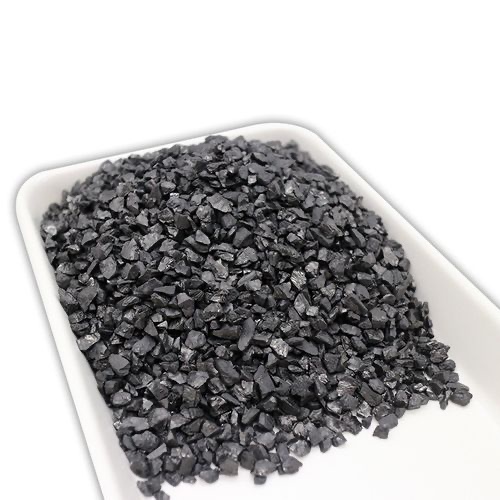
Made from low-ash, high-quality anthracite by cleaning, crushing, screening and water washing, this medium takes the form of black, irregular angular granules. Standard: CJ/T 43-2005 Filter Media for Water Treatment.
Role: a depth-filtration medium, not a biological carrier, most commonly used as the upper layer of a dual-media (coal-sand) filter.
2. Filtration Principle
Filtration relies on the rough, porous grain surface to provide physical interception together with shallow-layer adsorption, removing suspended solids, colloids and a small amount of organic matter from the water. Because its density is much lower than quartz sand, it floats to the top layer after backwashing, producing the ideal bed structure of coarse media above and fine media below. The water passes through the coarse anthracite first, so most impurities are retained in the surface layer, making full use of the deep-bed dirt-holding capacity and extending the filter run.
Density: 1.4-1.6 g/cm³ (quartz sand is about 2.65 g/cm³).
Porosity: 45%-52%.
Combined breakage and abrasion rate: ≤ 3%.
Hydrochloric acid solubility: ≤ 3.5% (acid and alkali resistant).
Bulk density: 0.9-1.05 t/m³.
Service life: 3-5 years.
4. Typical Process Configurations
Dual-media filter (the most common): anthracite on top, quartz sand below. Filtration rate 5-10 m/h, with a dirt-holding capacity far higher than a single-media quartz sand filter - a common solution for increasing output in waterworks upgrades.
Triple-media filter: anthracite + quartz sand + a heavy medium (magnetite).
In pressure filters (multi-media filters) the upper layer is rarely used on its own as single-media anthracite filtration.
5. Applications
Conventional rapid filters and V-type filters in municipal waterworks.
Advanced wastewater treatment and reclaimed water filtration.
Industrial water supply, circulating water pre-treatment and RO pre-filtration.
6. Advantages and Disadvantages
Advantages
Large pores, high dirt-holding capacity and long filter runs;
Low density means a lower backwash rate than quartz sand, saving water and power;
Better adsorption than quartz sand, with some removal of colloids and trace organics;
Good chemical stability; usable in water from pH 2 to 12.
Disadvantages
Cannot withstand prolonged oxidation by high concentrations of chlorine; over time it is oxidised and pulverised;
Incorrect grain size selection or excessive backwash rates cause anthracite loss;
More expensive than quartz sand;
Not suitable as a biological filter carrier; its biofilm attachment performance is far poorer than ceramsite.