
PRODUCT CENTER



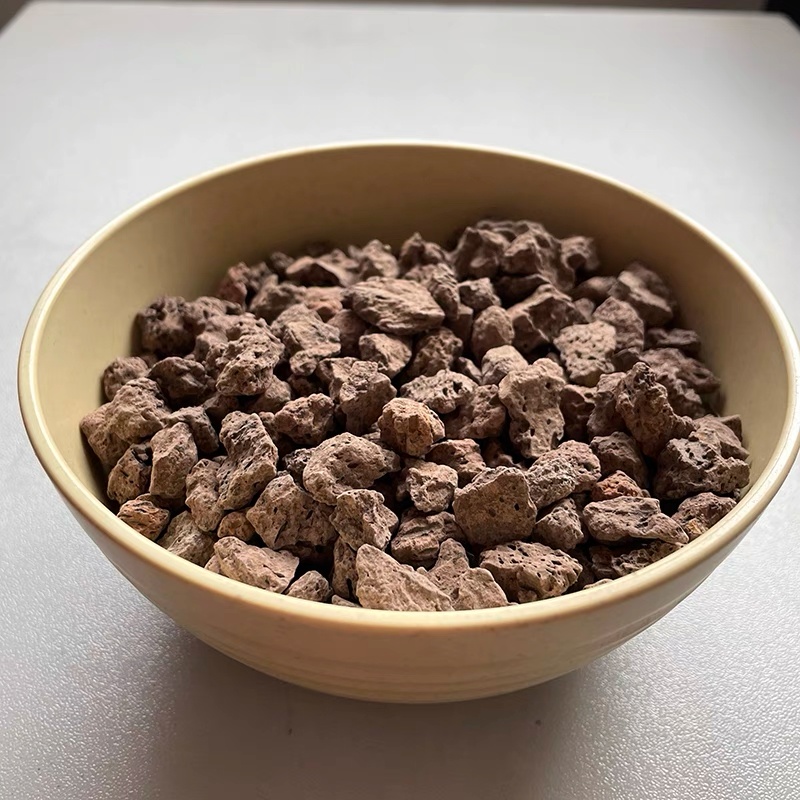


Volcanic Rock Filter Media
1. Overview
Volcanic rock media (porous basalt, pumice media) are produced from natural volcanic ore formed when erupting magma cooled rapidly, then processed by ore dressing, crushing, screening, washing and drying. With no chemical additives they are a natural inorganic water treatment medium. Appearance: irregular honeycomb-shaped granules in black or reddish-brown; black volcanic rock is preferred for water treatment, while the red variety is used mainly for horticulture and landscaping. Main constituents: silica, alumina, iron and manganese, together with more than twenty trace elements including potassium, magnesium and zinc.
2. Key Performance Characteristics
1. Porous with a large specific surface area: porosity 60%-84%, with abundant interconnected open pores that give micro-organisms ample attachment space, rapid biofilm development and a high biomass concentration, suitable for nitrifying and denitrifying populations.
2. Strong chemical stability: an inert material resistant to acid and alkali corrosion; hydrochloric acid solubility <1%, with no harmful substances leached during long-term immersion, giving high safety.
3. Lightweight with uniform water and air distribution: bulk density about 800-850 kg/m³; the granules have no sharp corners, so flow resistance is low and compaction and clogging are unlikely. Backwash performance is excellent and the biofilm is not easily detached.
4. Combines physical interception with biological degradation: it filters suspended solids while also acting as a biological carrier that degrades ammonia nitrogen and organic matter.
3. Typical Technical Parameters
| Parameter | Reference value |
| Porosity | 60%-84% |
| Bulk density | 800-850 kg/m³ |
| Compressive strength | ≥5 MPa |
| Abrasion rate | ≤1% |
| Hydrochloric acid solubility | <1% |
| Specific surface area | 14-26 m²/g |
| Initial biofilm formation time | approx. 27 h |
4. Common Grain Sizes
0.5-1 mm: water supply pre-treatment and micro-polluted source water filtration.
1-3 mm and 3-5 mm: aerated biological filters (BAF) and biological wastewater treatment.
5-10 mm: biological filters and advanced filtration.
10-50 mm: constructed wetlands, river ecological media and support layers.
5. Main Applications
1. Wastewater treatment: aerated biological filters and biochemical filters; advanced treatment of municipal wastewater, industrial organic wastewater and secondary effluent, and reclaimed water reuse, removing COD, ammonia nitrogen and total nitrogen.
2. Water supply treatment in waterworks: pre-treatment of micro-polluted source water, usable together with quartz sand, anthracite and activated carbon; removal of suspended solids, iron and manganese and trace organics, mostly in the advanced filtration stage.
Note: volcanic rock is generally not used as the main filter medium in waterworks; it is used mainly for pre-treatment or as the pre-carrier for biological activated carbon.
3. Ecological water treatment: constructed wetland substrate, remediation of black-odour rivers and ecological floating island media.
4. Other uses: biochemical filter media for aquaculture, soil improvement, and permeable media for sponge city systems.
6. Advantages and Disadvantages
Advantages: natural and environmentally friendly, with better biofilm attachment than quartz sand; large pores and a high volumetric loading rate; low backwash energy consumption and a long service life.
Disadvantages: overall compressive strength is lower than ceramsite media; fine granules carry a slight risk of pulverisation under prolonged high-intensity aeration; phosphorus removal by adsorption is limited and requires modified media.