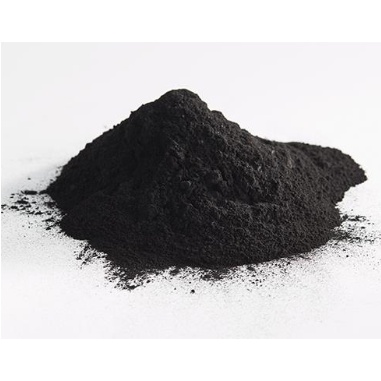
Produced from anthracite, wood sawdust or coconut shell / nut shell by carbonisation, high-temperature activation, acid washing and refining, and ultrafine grinding and screening. The material develops an extensive micro- and mesopore structure with a very large specific surface area (500-1,500 m²/g), capturing impurities in water by physical adsorption.
Wood-based powdered carbon: well-developed mesopores and excellent decolourising performance; used mainly for decolourising food products and liquid medicines.
Coal-based powdered carbon: balanced performance at moderate cost; the most commonly used type in waterworks and wastewater treatment plants.
Nut shell powdered carbon: rich in micropores and particularly good at adsorbing small-molecule odours and trace organics.
Iodine number: indicates the capacity to adsorb small-molecule organics; 900-1,050 mg/g is typical for water treatment.
Methylene blue number: indicates the capacity to adsorb and decolourise larger molecules and pigments.
Moisture ≤ 10%; ash content 3-10%; pH 6-10.
3. Main Advantages and Disadvantages
Advantages
Fine particles give thorough contact with the water, fast adsorption and rapid results.
Flexible in use: it can be dosed as dry powder or as a carbon slurry. No new fixed filter bed is needed and civil works modifications are minimal, which makes it ideal for emergency treatment of sudden odour events and seasonal pollution - the most typical use in waterworks.
It also provides some coagulant-aid effect and can be used together with coagulation.
Disadvantages
Dosed once only and not recoverable or regenerable; it is a consumable.
Once saturated it must be removed by settling tanks and filters; incomplete separation causes black effluent and clogged media.
Overdosing increases sludge production.
4. Main Applications
Waterworks (the most frequent application): emergency removal of taste and odour, algal metabolites, trace organics and disinfection by-product precursors.
Sewage treatment and industrial wastewater: removal of COD, colour and some heavy metals.
Food and pharmaceutical industry: decolourising sugar liquors, alcoholic beverages and injection solutions, and depyrogenation and purification.