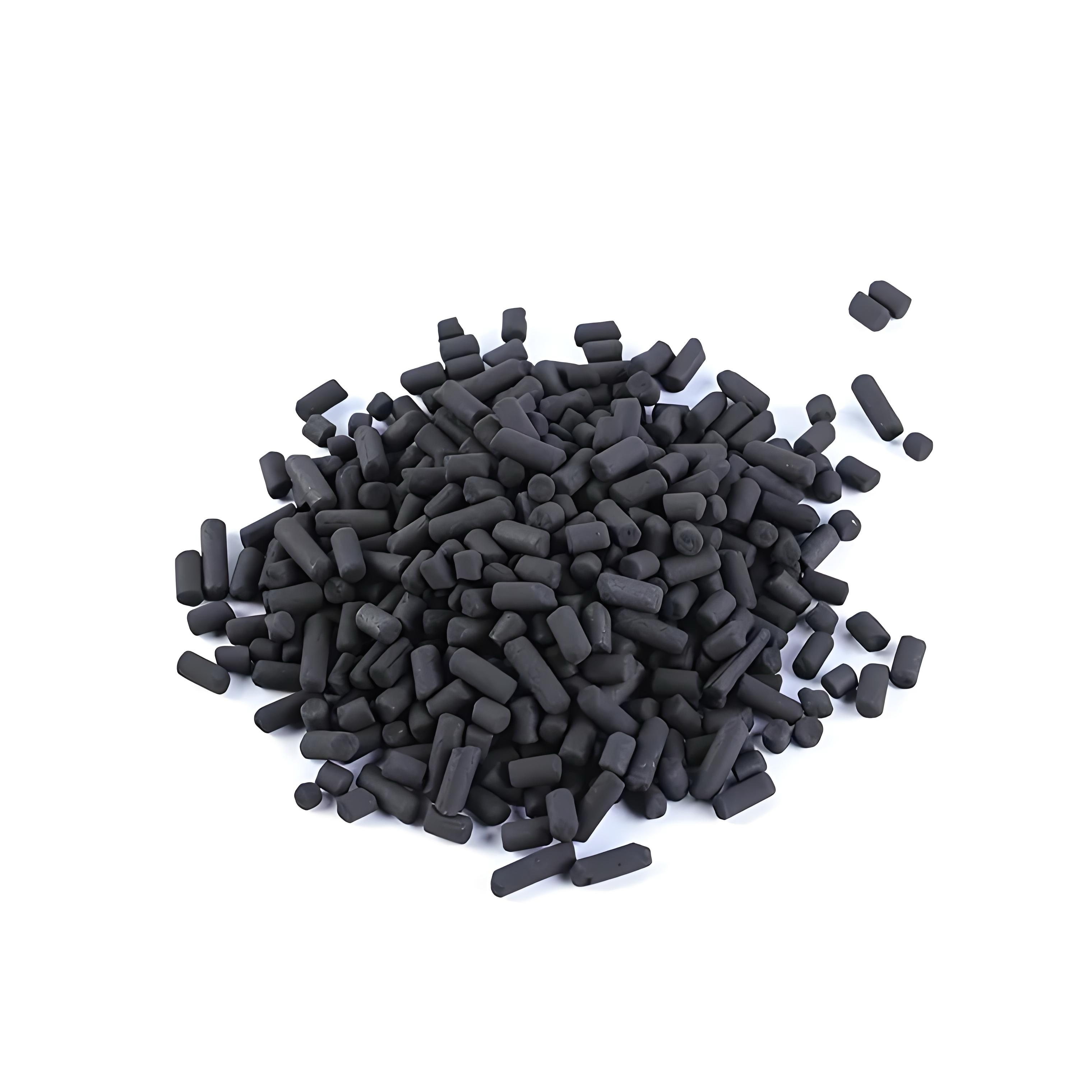
Produced from anthracite, wood sawdust or coconut shell powder: the raw material is ground, mixed with a binder and extruded into shape, then carbonised and activated at high temperature.
Coal-based extruded carbon: the most widely used type for water treatment and waste gas, with well-developed macro- and mesopores and an excellent cost-performance ratio (advanced treatment in waterworks).
Wood-based extruded carbon: rich in mesopores, with strong decolourising capacity.
Common sizes (diameter): Φ1.5, 2, 3, 4, 6 and 8 mm; length 5-15 mm.
2. Key Technical Specifications for Waterworks (CJ/T 345-2010)
Parameter
Specification
Iodine number
≥950 mg/g
Specific surface area
≥950 m²/g
Hardness
≥90%
Moisture content
≤5%
Floating rate
≤2%
Apparent (bulk) density
≥380 g/L
pH
6-10
For gas-phase applications the carbon tetrachloride (CTC) adsorption rate is the key parameter; for water treatment the iodine number and hardness matter most.
3. Advantages and Disadvantages
Advantages
High mechanical strength, wear resistant and not easily pulverised, with low dust generation and low backwash losses.
Regular granule shape gives uniform bed packing and stable water/air flow resistance, suitable for continuous operation of fixed-bed activated carbon filters.
Once saturated the carbon can be removed and regenerated for reuse, at a lower operating cost than single-use powdered carbon.
Does not wash out with the effluent, so there is no risk of black water.
Disadvantages
The larger granule size means slower contact with the water and slower adsorption than powdered carbon, so it cannot be used for emergency short-term dosing.
Requires construction of an activated carbon filter, with significant civil works investment.
There is a risk of filter clogging and bed compaction, so regular backwashing is required.
4. Typical Applications
Advanced treatment in waterworks (ozone + activated carbon process): removal of trace organics, taste and odour, and disinfection by-product precursors, giving long-term water quality stability.
Advanced treatment of industrial wastewater and sewage: removal of COD and colour.
Waste gas purification, VOC abatement, odour removal in paint spray booths and solvent recovery (extruded carbon is very widely used in gas-phase applications).