
PRODUCT CENTER



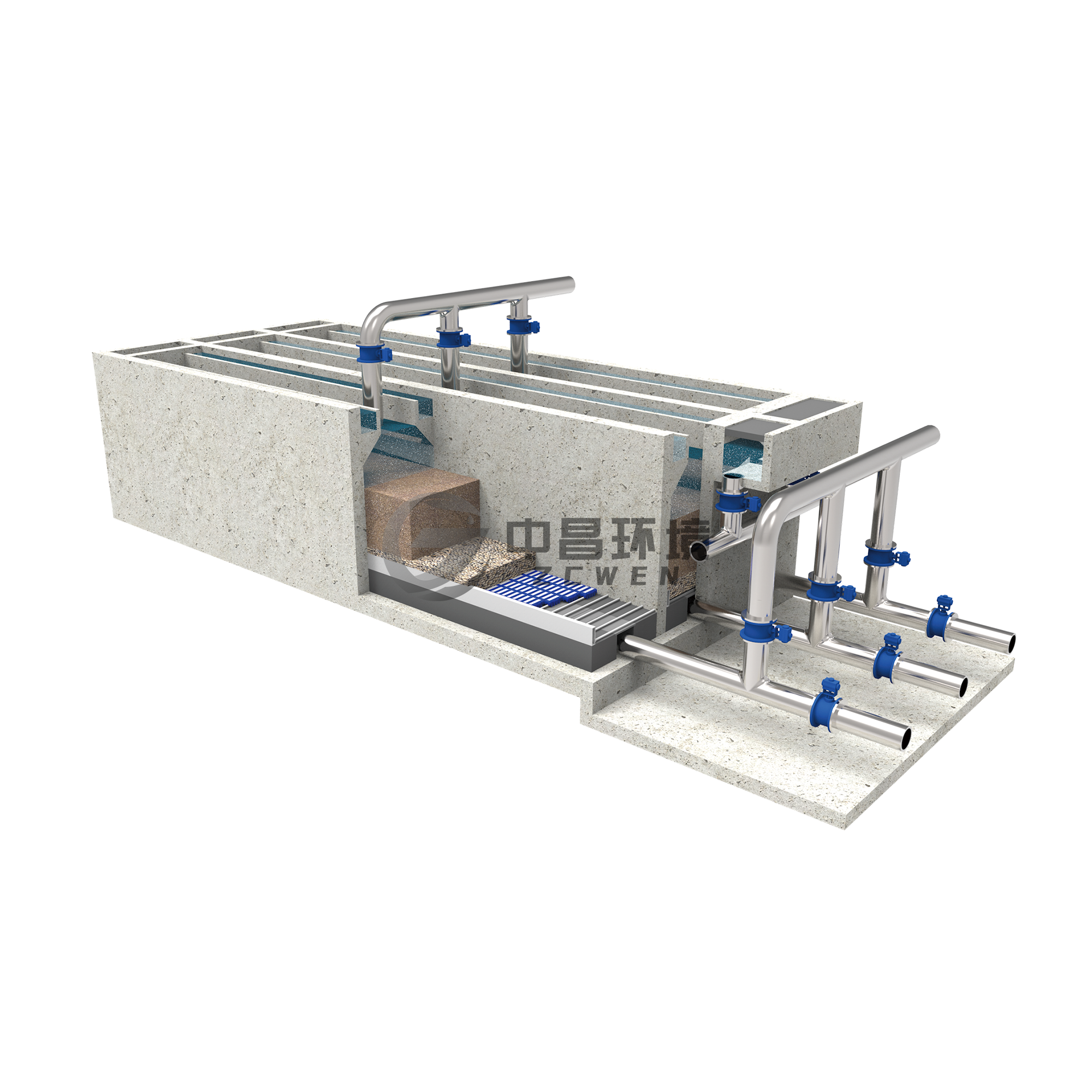


Downflow Biological Filter - Denitrification Deep Bed Filter

Overview
The denitrification deep bed filter is an advanced treatment unit that combines biological denitrification with filtration. It uses thick-layer homogeneous media of a special size and shape as the carrier for the denitrifying biofilm. With an external carbon source it becomes a denitrification deep bed filter capable of removing TN, SS and TP. Without an external carbon source it operates as a deep bed filter removing SS and TP.
Principle of Biological Denitrification
Denitrification is a biochemical process carried out by a group of heterotrophic micro-organisms.
Under anoxic conditions (in the absence of dissolved molecular oxygen) nitrite and nitrate are reduced to nitrogen gas, nitric oxide or nitrous oxide. The micro-organisms taking part in denitrification are denitrifying
bacteria. Denitrifying bacteria are facultative and occur almost everywhere in the natural environment; many common micro-organisms in wastewater treatment systems are denitrifiers, including Proteus, Micrococcus, Pseudomonas, Bacillus, Alcaligenes and Flavobacterium, most of which are facultative. When dissolved oxygen is present, denitrifiers break down organic matter using molecular oxygen as the final electron acceptor. In the absence of dissolved oxygen they use the nitrate nitrogen (N5+) and N3+ of nitrate and nitrite as electron acceptors in energy metabolism, with O2- as the hydrogen acceptor to produce H2O and OH- alkalinity, while organic matter serves as the carbon source and electron donor, supplying energy and being oxidised and stabilised. The biological denitrification process can be expressed by the following two equations:
2NO2- + 6H (organic electron donor) = N2 + 2H2O + 2OH-
2NO3- + 9H (organic electron donor) = N2 + 3H2O + 3OH-
Factors Affecting Denitrification
Temperature
The optimum temperature range for denitrification is 20-40 °C; below 5 °C the reaction rate falls.
pH
The optimum pH for denitrification is 7.0-7.5. An unsuitable pH affects the proliferation of denitrifying bacteria and their enzyme activity; below pH 6.0 or above pH 8.0 denitrification is markedly inhibited.
Dissolved Oxygen
Microbial denitrification requires strictly anoxic conditions. In activated sludge systems the dissolved oxygen should generally be kept below 0.5 mg/L for denitrification to proceed normally. In attached-growth systems, however, the biofilm offers greater resistance to oxygen transfer, so higher dissolved oxygen concentrations can be tolerated.
Carbon Source (Organic Matter)
Denitrification is a biochemical reaction carried out by heterotrophic micro-organisms. Under very low dissolved oxygen concentrations they use the oxygen in nitrate as the electron acceptor, with organic matter as the carbon source and electron donor. The denitrification rate varies with the carbon source used. As regards toxic substances, denitrifying bacteria are far less sensitive than nitrifying bacteria and are comparable to ordinary aerobic heterotrophs.


Filter Media
The media in a denitrification deep bed filter serve the dual function of turbidity removal and biofilm denitrification.
High-strength crushed homogeneous ceramsite media
Raw material: bentonite, which overcomes surface glazing and improves surface hydrophilicity, enhancing the auxiliary function of the biofilm. Biofilm start-up is fast and attachment efficiency is high (equivalent to imported Norwegian media). The surface roughness and porosity provide good attachment conditions and an ideal growth environment for microbial flocs.
Biochemical stability: good corrosion resistance, not readily attacked by acid.
Strength: high mechanical strength, friction resistant and wash resistant.
Grain size range: 2.0-4.0 mm for deep beds of 1.8 m and above. Depending on water quality and bed depth, other homogeneous grades such as 1.2-2.0 mm and 0.9-1.2 mm can be selected flexibly and on a sound technical basis.
Conventional homogeneous quartz sand media
High specific gravity media - minimum 2.6.
High-grade silica sand.
Grain size range 2.0-4.0 mm.
Uniformity coefficient below 1.35.
Sphericity 0.80.
Mohs hardness >6.
Sandwich-Type Support Layer
With a thickness of 380-500 mm, the sandwich-structured support layer is an indispensable element of a deep bed filter. It not only supports the media and keeps the bed stable during backwashing, but is also the technical guarantee of uniform water and air distribution.
Water and Air Distribution System
Made from high-strength materials that resist damage, with a service life of more than 30 years and a load capacity of over 8 tonnes, requiring no replacement or maintenance costs. Water and air are distributed evenly with no backwash dead zones. Different types and sizes of filter brick can be selected to suit the situation, and installation is quick and easy.


When the BOD5/TN ratio of the wastewater is greater than 3-5, the carbon source for denitrification is considered sufficient. When organic matter is lacking, an external carbon source must be added to provide enough electron donors for denitrification.

Operation
Backwashing
The fully automatic backwash sequence is as follows (the backwash interval and sequence can be adjusted from the main control cabinet):
(1) Close the inlet and outlet valves;
(2) open the backwash inlet and backwash outlet valves;
(3) open the backwash air control valve;
(4) start the backwash Roots blower;
(5) gradually close the backwash air relief valve and begin air scouring;
(6) with the blower still running, start one backwash pump after 5 minutes of air scouring;
(7) combined air-water backwash for about 15 minutes;
(8) stop the backwash Roots blower, close the backwash air control valve and open the air relief valve.
(9) continue water-only rinsing for about 5 minutes to remove residual air from the filter and flush residual matter out of the cell.
(10) stop the backwash pump.
(11) close the backwash inlet and backwash outlet valves.
(12) open the inlet and outlet valves and return the filter to normal operation.

Nitrogen Driving
During combined air-water backwash or water-only rinsing, if another denitrification cell has an excessively high water level, a second pump is started to drive out nitrogen. Nitrogen driving lasts 1-2 minutes, and the cycle can be set from the main control cabinet supplied with the filter.
Operating Cost

Technical Advantages
Versatility: a single denitrification deep bed filter performs several duties, simultaneously and reliably meeting three water quality targets - TN (with carbon dosing), SS (downflow gravity filtration) and TP (co-flocculation). After treatment the effluent TSS can be as low as 3 mg/L or less (typically 5-10 mg/L), TP as low as 0.3 mg/L or less (typically 0.5 mg/L) and TN as low as 3 mg/L.
Reliability as a TN safeguard: because the upstream processes at most wastewater treatment plants in China are relatively fragile and effluent quality fluctuates considerably, the filter acts as a safeguard that keeps TN reliably within limits and can meet progressively stricter TN discharge standards in the future. The effluent carries no residual biofilm and the water quality is stable and dependable.
Economy and process flexibility: if TN is already within limits in summer, the operating conditions can simply be changed so that the denitrification deep bed filter switches flexibly to a deep bed filter without starting the carbon dosing system. This adapts to seasonal variation and saves operating cost, giving excellent economy.
Low capital cost: the submerged inlet weir and the proprietary nitrogen-driving technique ensure minimum carbon source consumption and energy consumption.
Wear parts: the denitrification deep bed filter is maintenance-free for life, with no wearing or consumable parts.