
PRODUCT CENTER



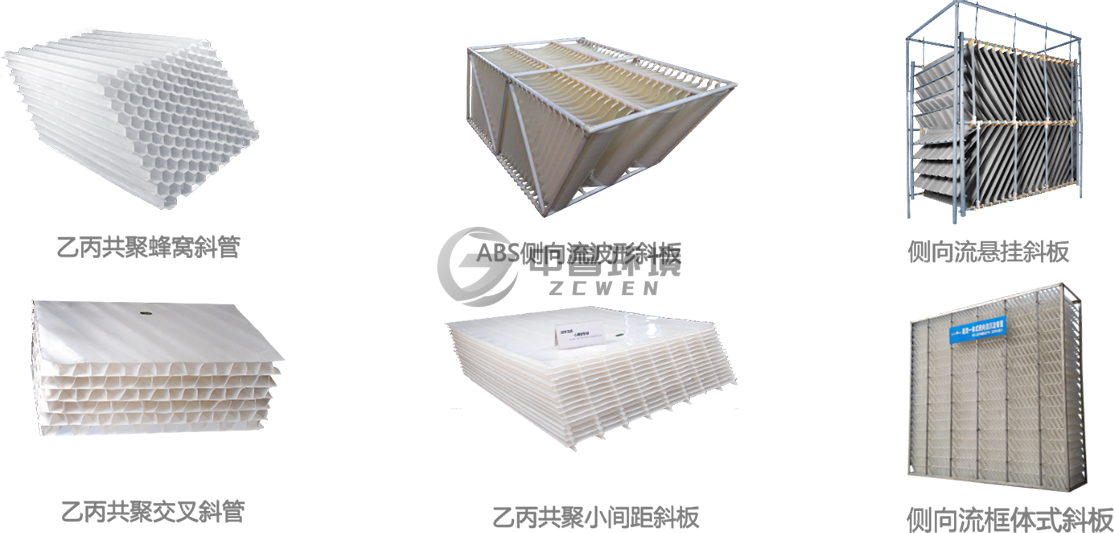


1. Inclined Tubes
Inclined tubes are a widely used high-efficiency settling device. They operate at a high Froude number and a low Reynolds number in well-developed laminar flow, so SS settling is not disturbed by turbulence, giving a treatment capacity several times that of horizontal sedimentation, accelerated clarification or pulsating sedimentation. We import specialised production equipment and use advanced processing; each module has a square cross-section, high strength, accurate geometry, smooth internal and external sludge-sliding walls and good ageing resistance.
Specifications
Tube diameter 25-100 mm (to customer requirement); sheet thickness 0.3-1.5 mm (to customer requirement).
Module size 1,000 x 1,000 x 1,000 mm (to customer requirement).
Standard inclination 60°.
Any inclination from 30° to 70° (maximum inclined length 3 m).
Material
Ethylene-propylene copolymer, stainless steel.


2. Close-Spaced Inclined Plates
Specifications:
Plate spacing: 25-100 mm (to customer requirement);
sheet thickness 1.0-2.0 mm (to customer requirement);
module size 1,000 x 1,000 x 1,000 mm (to customer requirement);
standard inclination 60°;
any inclination from 30° to 70°.
Material:
Ethylene-propylene copolymer, stainless steel.

3. PP Cross-Flow Inclined Tube Modules
In the UNITANK process, conventional inclined tube settlers have a single inclination direction. Although this can achieve effective shallow-layer settling, the flow entering the settling tank includes not only forward flow but also reflected flow and density currents, so conventional settlers adapt poorly to the hydraulic conditions. PP cross-flow inclined tube settlers are clearly more advanced than conventional single-direction tubes.
Advantages of PP cross-flow inclined tube modules
When the biological reaction tank is in the aeration phase, the base of the tubes is subjected to a strong, irregular upward thrust from the air-water mixture. The cross-flow arrangement releases this upward thrust evenly and in balance through the staggered adjacent openings, whereas conventional tubes with all openings in the same direction often cannot release it effectively.
The geometry of the lower layer cuts and disperses the rising aeration bubbles effectively, helping to distribute air and water evenly and improve oxygen utilisation.
The staggered layout of the cross-flow tubes enhances contact between the air and the mixed liquor, raising the transfer rate of oxygen into the wastewater.
When aeration stops, the activated sludge settles rapidly. Cross-flow tubes let the sludge settle evenly and uniformly across the tank floor without blocking the openings, whereas conventional tubes with a single direction cannot distribute the settled sludge evenly, reducing biological nitrification efficiency in local areas.
Structural features of PP cross-flow inclined tube modules
The cross-flow module is an assembly made from polypropylene sheet: 60° continuous trapezoidal inclined tube sections formed by hot pressing, together with flat sheets cut to size, welded in successive crossing layers.
Made of PP: lightweight, corrosion resistant, rigid and non-deforming, with strong resistance to shock loads.
Smooth surface, free from cracks and bubbles, with no significant colour variation, inclusions, raised or hollow spots, and no signs of ageing.
With a 60° inclination and a crossing arrangement, the tubes give good sludge sliding, no dead zones and excellent hydraulic conditions. The large specific surface area readily supports a substantial biofilm, giving a high volumetric loading rate.